|


First
off...
What is a "Cog" Railway?
Conventional railroads use the friction of wheels upon the rails,
called "adhesion", to provide locomotive power. A cog, or rack, railroad uses a
gear, "cog wheel", meshing into a special rack rail (mounted in the
middle between the outer rails) to climb much steeper grades than those possible
with a standard adhesion railroad. An adhesion railroad can only climb grades of 4
to 6%, with very short sections of up to 9%. A "rack" railroad can
climb grades of up to 48%, depending upon the type of rack system employed. Some Swiss
trains use a combination of "rack" and "adhesion". This enables the
trains to reach much higher speeds on the adhesion sections (rack railroads can not go
much faster than 25 miles per hour or they run the risk of dislodgement from the rack rail-
M & PP Ry.'s top speed is about 9 MPH).
The first cog (or "rack") railway was built in New
Hampshire in 1869,
but the Swiss were quick to make use of this technology, and
numerous rack railways were built there. Indeed, Switzerland is still the country
where most rack railways are located. The Manitou and Pikes Peak
Railway is,
however, the highest rack railway in the world as well as the highest railway in North
America and the Northern Hemisphere. The M&PP Ry. has a perfect safety record!
Photo-Gornergratbahn
 |
The Manitou & Pikes Peak Railway uses the Abt rack system. The
maximum grades are 25%, which is about the upper limit for the Abt system. Many
rack railroads use the Riggenbach system, also called "ladder rack". The
steepest cog railway in the world is the Mt. Pilatus Railway in Lucerne, Switzerland. It
uses the Locher rack system to climb grades of 48% !
(P.S. Thanks to Mr. Frick, former Pres. and General Manager of the M &
PP Ry. for pointing out the correct grade of the Pilatusbahn and proofing the technical
and historical sections of this site.)

Photo courtesy Tom Jamison & Family
HISTORY OF THE PIKES PEAK COG RAILWAY
One of the tourists who visited the Pikes Peak region in the
late-1880's was Zalmon Simmons, inventor and founder of the Simmons
Beautyrest Mattress Company. Mr. Simmons rode to the summit of
Pike's Peak on a mule, partly to enjoy the view and partly to check upon one of
his inventions: an insulator for the telegraph wires which ran to the Army Signal Station
on the summit. The arduous, two day trip on a mule was the only way to reach the top in
those days. Mr. Simmons was awed by the scenery but determined that the views
should be experienced in a more civilized and comfortable manner. He was relaxing
in one of Manitou Springs' mineral baths after his return, when the owner of his Hotel
mentioned the idea of a railway to the top. Mr. Simmons agreed with the concept and set
about providing the capital needed to fund such a venture.
|
 |
|
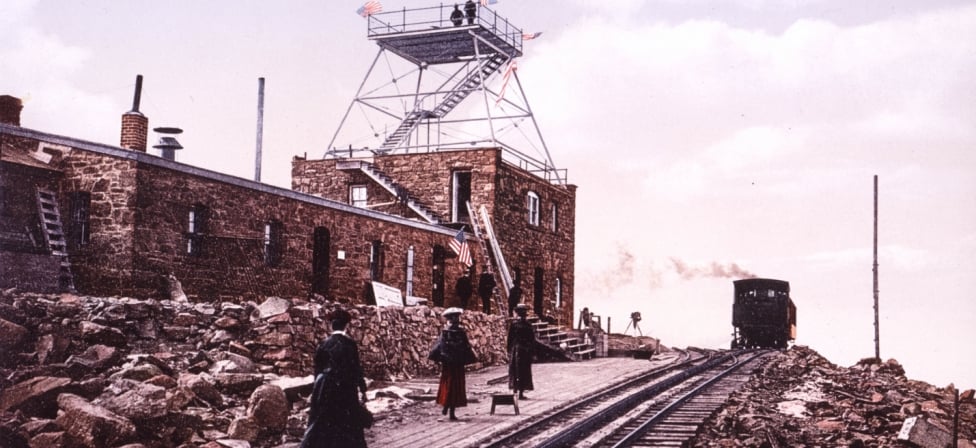
In 1889, the Manitou & Pike's Peak Railway Company was founded and
track construction began in earnest. Top wages were 25 cents per hour. Six workers died in
blasting and construction accidents. The Age of Steam
predominated the late 1800s, and from Baldwin Locomotive Works
in Philadelphia, Pennsylvania, three engines were delivered in 1890. Limited service was
initiated in that year to the Halfway House Hotel . These locomotives were eventually
converted to operate upon the Vauclain Compound principle, and a total of six were in
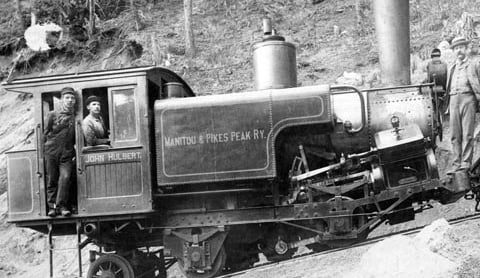
service during the "steam" era. The original three were named "Pikes
Peak," "Manitou" and "John Hulbert," but they soon were assigned
numbers. Of the original six, only #4 is still in operation and along with a restored
coach makes infrequent trips short distances up the track.
The spring of 1891 was a snowy one, and the opening of
the line was delayed until late June. On the afternoon of June 30th, 1891,
the
first passenger train, carrying a church choir from
Denver, made it to the summit. A scheduled group of dignitaries had been
turned back earlier by a rock slide around 12,000 feet. The railway was now operating.
_______________________________________________________
| A new era began in the late 1930s
with the introduction of gasoline and diesel powered locomotives. Spencer
Penrose, owner of The Broadmoor Hotel, had acquired the Railway in 1925 and efforts were
begun to build a compact, self-contained railcar, which could carry fewer passengers
during the slow parts of the season. These efforts culminated in No. 7; a gas-powered,
23-passenger unit, which made its first run on June 16, 1938. It is believed that
No. 7 is the first rack railcar ever built in the world. |
 |
The experiment was a huge success,
and within a year of No. 7s introduction, No. 8, the worlds first
diesel-electric cog locomotive, was delivered from the General Electric
Company. Coupled with "Streamliner" coaches, No.s 8, 9, 10, 11, and 12
formed the backbone of the Railways fleet in the period from 1940 through 1965. The
coaches could carry 56 passengers in comfort and style, and the diesel locomotives
eliminated the time-consuming water stops as well as the back-breaking job of shoveling
coal.
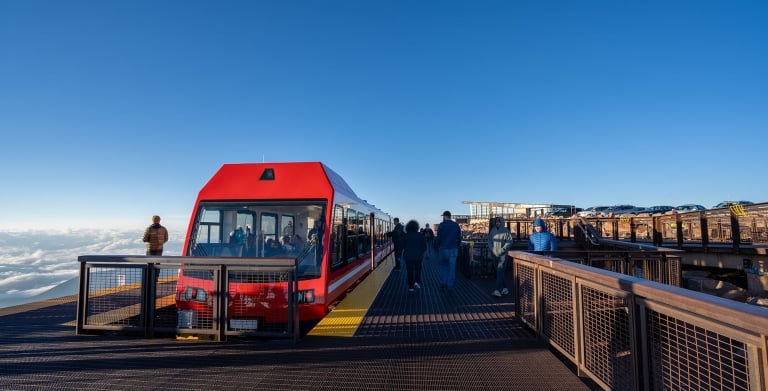
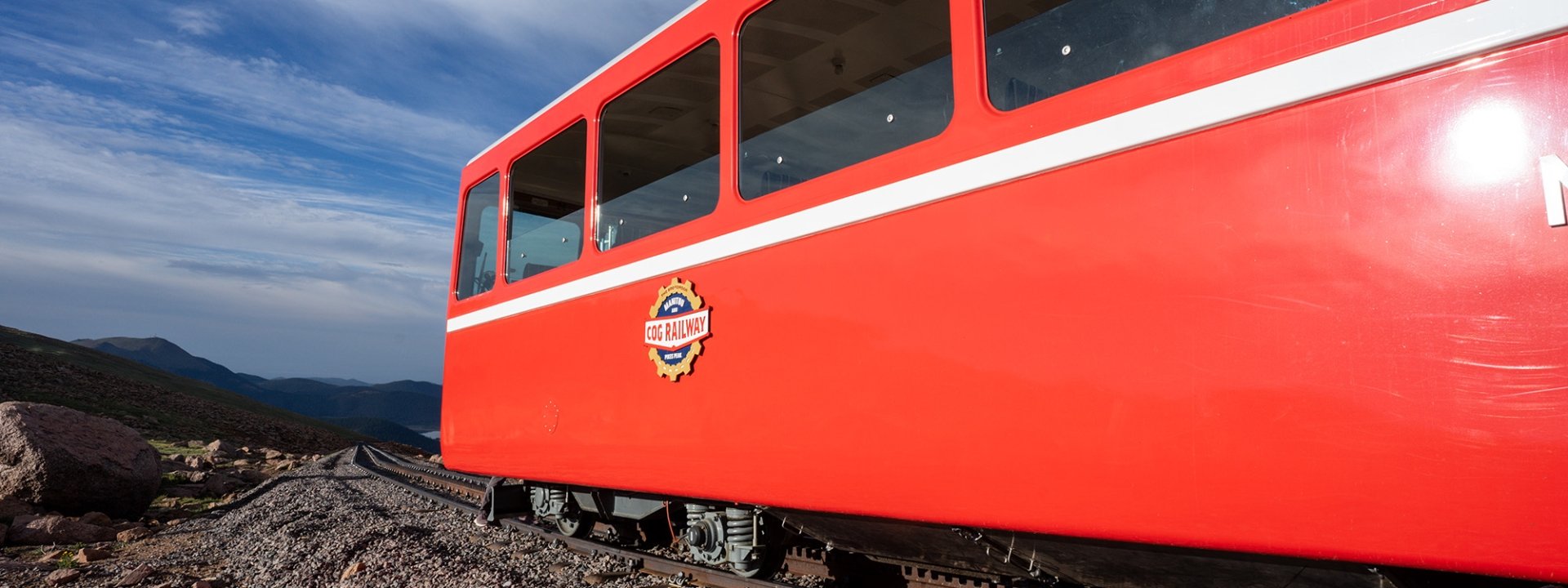
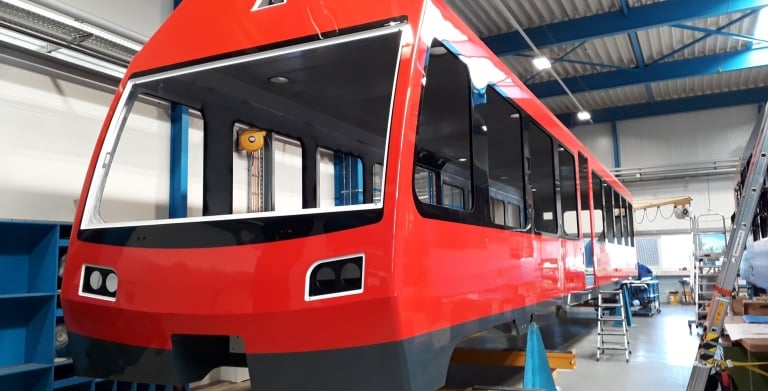
FOR THE MODERN ERA (SWISS TRAINS) AND FOR INFORMATION ABOUT OUR SNOW
PLOWING TECHNIQUES THROUGH THE YEARS, PLEASE GO TO
SWISS TRAINS & SNOW PLOWS.
MANITOU & PIKES PEAK RAILWAY
515 RUXTON AVE. / PO BOX 351
MANITOU SPRINGS, CO 80829
719 685 5401
FAX- 719 685 9033 -FAX
e-mail: info@cograilway.com |

Cog Ry Home / Along the Route / History / About Pikes Peak / Rates-Reservations
/ Gift Shop / Special
Events / SNOW / Swiss Trains / Rail-Colorado Links / Employment
/ What's a Cog? / Lodging
/ DIRECTIONS /
Maintenance
/ Discount Coupon
ALL PHOTOS AND DRAWINGS (except Gornergratbahn, Zebulon Pike) ARE
PROPERTY OF THE M&PPRY.
|